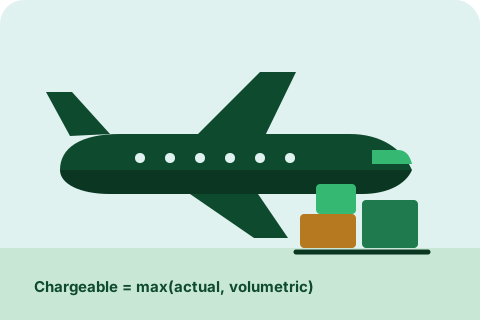
Air freight is priced per kilogram — but not always per real kilogram. Light, bulky cargo takes up space in the aircraft that could have carried heavier goods, so airlines charge on whichever is greater: the actual weight or the volumetric weight.
Actual weight
The actual (gross) weight is what the cargo weighs on a scale, including cartons, packaging and pallets.
Volumetric weight
Volumetric (or dimensional) weight converts the volume of the cargo into a notional weight:
The divisor depends on the carrier:
| Divisor | Typically used by |
|---|---|
| 6000 | Most airlines and air freight forwarders (IATA standard) |
| 5000 | Many express couriers |
| 7000 | Some carriers and routes with special agreements |
With a 6000 divisor, 1 CBM equals about 167 kg of volumetric weight.
Chargeable weight
Example
10 cartons of 50 × 40 × 40 cm, each weighing 9 kg:
- Actual weight: 10 × 9 = 90 kg
- Volume per carton: 50 × 40 × 40 = 80,000 cm³
- Volumetric weight per carton (6000): 80,000 ÷ 6000 = 13.33 kg
- Total volumetric weight: 133.3 kg
- Chargeable weight: 133.3 kg (volumetric is higher)
At $4.20 per kg, the freight is about $560 — not the $378 you might expect from the actual weight.
How to reduce chargeable weight
- Use cartons that fit the product closely; avoid shipping air.
- Combine small items into fewer, well-filled cartons.
- Avoid oversized pallets for light goods, or ship loose cartons where allowed.
- Ask your forwarder which divisor applies — 6000 instead of 5000 lowers volumetric weight by about 17%.
- For very bulky, light goods, compare with sea freight.
Calculate it automatically
MYCBM's Air Freight Calculator shows actual, volumetric and chargeable weight side by side, lets you switch between the 5000, 6000 and 7000 divisors, and calculates the total cost from your rate per kg.
Try the calculator from this guide
Calculate CBM, freight costs and container fill in seconds with MYCBM.