Choosing between sea and air freight is a trade-off between cost and speed. The right answer depends on your cargo, your deadlines and your margins.
At a glance
| Sea freight | Air freight | |
|---|---|---|
| Cost | Low per kg/CBM | High per kg |
| Transit time | Weeks | Days |
| Best for | Large, heavy or low-value cargo | Urgent, light, high-value cargo |
| Pricing basis | CBM (or W/M) / container | Chargeable weight (kg) |
| Size limits | Very flexible | Limited by aircraft and pallets |
When sea freight makes sense
- Shipments above roughly 2–3 CBM or a few hundred kilograms.
- Low or medium value goods where freight is a big share of the price.
- Products that are not urgent and can be planned ahead.
- Heavy or bulky goods such as furniture, machinery and building materials.
When air freight makes sense
- Urgent orders, samples and replacement parts.
- High-value, low-volume goods (electronics, cosmetics, fashion).
- Perishable or time-sensitive products.
- Small shipments where the sea minimums and fees dominate.
A simple break-even check
- Calculate the sea cost: total CBM × rate per CBM + fixed fees.
- Calculate the air cost: chargeable weight × rate per kg + fixed fees.
- Compare the difference with the value of getting the goods sooner — lost sales, storage, cash tied up in stock.
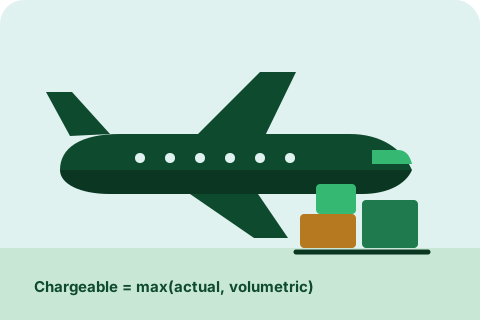
Remember that 1 CBM equals about 167 kg of volumetric weight in air freight (6000 divisor). Bulky goods that are cheap by sea can be very expensive by air.
Other options
- Sea-air: sea to a hub, then air — a middle ground on cost and time.
- Rail from China to Europe and Central Asia on some routes.
- Express couriers for very small, urgent parcels.
Compare both in MYCBM
MYCBM has both a Sea Freight Calculator and an Air Freight Calculator, so you can price the same cartons both ways — CBM and cost per CBM by sea, chargeable weight and cost per kg by air — before you book.
Try the calculator from this guide
Calculate CBM, freight costs and container fill in seconds with MYCBM.