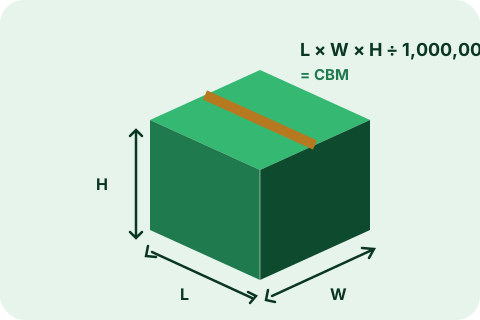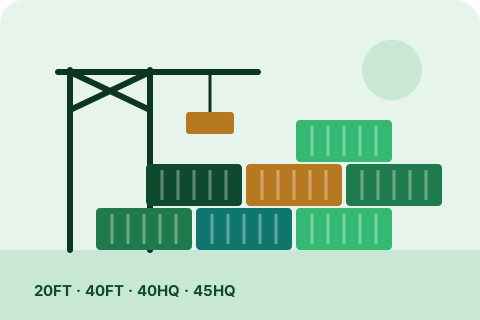
"Will my order fit in one container?" is one of the most common questions importers ask. The answer starts with CBM.
Quick answer
| Container | Nominal capacity | Realistic load (cartons) |
|---|---|---|
| 20FT | ~33 CBM | ~25–28 CBM |
| 40FT | ~67 CBM | ~55–58 CBM |
| 40HQ | ~76 CBM | ~65–68 CBM |
| 45HQ | ~86 CBM | ~72–78 CBM |
The realistic figure is lower than the nominal one because cartons and pallets never fill every gap.
How many cartons fit?
Divide the realistic loadable volume by the CBM of one carton:
Example: a carton of 60 × 40 × 50 cm is 0.12 CBM. In a 40HQ with ~66 CBM of usable space:
66 ÷ 0.12 ≈ 550 cartons
This is an estimate. The exact number depends on how carton dimensions fit the container's internal length, width and height, and on whether cartons can be rotated or stacked.
Container utilization
Utilization tells you how full the container is:
If your shipment is 30 CBM:
- 20FT (33 CBM): 91% — too tight once packing gaps are considered;
- 40FT (67 CBM): 45% — you are paying for a lot of empty space;
- consider LCL, splitting the shipment, or adding more goods to fill a 40FT.
Tips for better utilization
- Choose carton sizes that divide well into 2.35 m width and 2.39 m (or 2.69 m) height.
- Load heavy cartons at the bottom and toward the centre.
- Consolidate orders from several suppliers into one container — see our shipment consolidation guide.
- Check the weight limit as well as the volume.
See the fill percentage instantly
MYCBM shows the estimated fill for 20FT, 40FT, 40HQ and 45HQ containers as you enter cartons, and in a consolidation it sums every product so you know when the container is full.
Try the calculator from this guide
Calculate CBM, freight costs and container fill in seconds with MYCBM.